Which word describes the specialty of noun or
pronoun in the sentence is called an adjective.

Before noun to describe:
- Ani Majang Ajang – My beautiful sister.
- Thaiju Gimin – Ripe mango.
- Saam Gakhrang – Green grass.
After noun/pronoun but before the verb:
- Bo Ane Thane Dedao – He is older than me.
The adjective in Dimasa follows the noun it
qualifies, as
- A good child – Ansa Hamba.
- A tightrope – Wahdu Gejepba.
But when an
adjective is compounded with the relative particle ‘ya’, it precedes the noun
it qualifies, as:-
- Hamyaba
Ansa – A good child. - Thuyaba Di –
Water which is deep. - Gejepyaba
Wahdu – A rope that is tight.
The
emphatic form of the adjective ends in ‘Bi’, instead of ‘Ba’, as:-
- Ebo Ansa
Hambi – This child is good. - Ebo Di
Thubi Thi? – Is this water deep?
Note: This
is not a feminine form.
There is
another form of the adjective, beginning with ‘G’ followed by a vowel corresponding
to the sound of the next following syllable, the termination ‘ba’, or ‘bi’,
being dropped. Thus-
- Khaba –
Bitter – Gakha - Diba –
Sweet – Gidi - Thuba –
Deep – Guthu
* This form
of adjective follows the noun it qualifies.
Adjectives
undergo no change of termination, either in gender or number, to agree with the
noun they qualify.
The case
ending is always attached to the qualifying adjective, as–
- Houbo Ansa
Hamba Ne Riha – Give it to that good child.
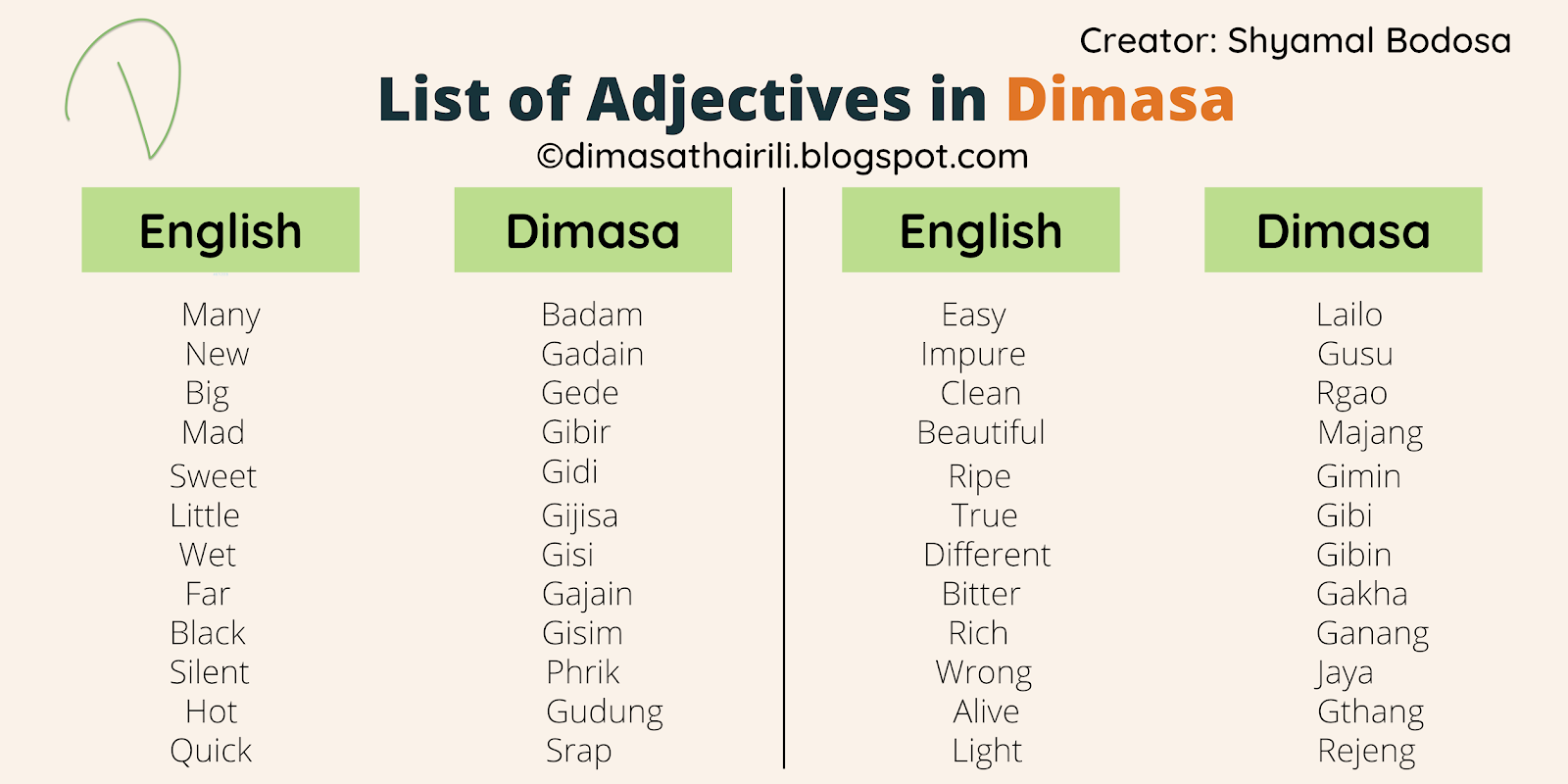
List of Adjectives in Dimasa
table {
border-collapse: collapse;
width: 100%;
}
th, td {
padding: 8px;
text-align: left;
border-bottom: 1px solid #DDD;
}
tr:hover {background-color: #D6EEEE;}
58 Dimasa Adjectives List with English Meaning
| No. | English | Dimasa |
|---|---|---|
| 1 | Many | Badam |
| 2 | Torn | Gabai |
| 3 | Much/more | Gbang |
| 4 | New | Gadain |
| 5 | Straight | Gebeng |
| 6 | Simple | Gebleng |
| 7 | Big | Gede |
| 8 | Bigger | Dedao |
| 9 | Biggest | Dedaothao |
| 10 | Flat | Gepher |
| 11 | Twice | Alangini |
| 12 | True | Gibi |
| 13 | Mad | Gibir |
| 14 | Sweet | Gidi |
| 15 | Little | Gijisa |
| 16 | Soft/unripe | Gili |
| 17 | Ripe | Gimin |
| 18 | Wet | Gisi |
| 19 | Black | Gisim |
| 20 | Far | Gajain |
| 21 | Old/ancient | Gjam |
| 22 | Red | Gajao |
| 23 | Green | Gkhrang |
| 24 | Bitter | Gakha |
| 25 | Rich | Ganang |
| 26 | Long | Galao |
| 27 | Straight for horizontal | Gosong |
| 28 | Dry | Garain |
| 29 | Clever | Grik |
| 30 | Cold | Gasain |
| 31 | Alive | Gthang |
| 32 | Pure | Gthar |
| 33 | Hot | Gudung |
| 34 | High | Guju |
| 35 | White | Guphu |
| 36 | Yellow | Gurmu |
| 37 | Brown | Gurmuli |
| 38 | Impure | Gusu |
| 39 | Better | Hamdao |
| 40 | Best | Hamdaothao |
| 41 | Short | Hilik |
| 42 | Hungry | Hukhri |
| 43 | Wrong | Jaya |
| 44 | Darktan | Jaosim |
| 45 | Sad | Kha-bai |
| 46 | Small | Khase |
| 47 | Smallest | Khasedaothao |
| 48 | All | Khrib |
| 49 | Easy | Lailo |
| 50 | Ill | Lim |
| 51 | Beautiful | Majang |
| 52 | Quick | Srap |
| 53 | Angry | Thamsi |
| 54 | Heavy | Risi |
| 55 | Everyday | Nalai bo |
| 56 | Blue | Simkhrang |
| 57 | Tasty | Thao |
| 58 | Worry | Waimu |
Comparison of Adjectives
The
comparative degree is formed by adding ‘dao’ to the positive and inserting the
particles ‘ne’ or ‘netha’, after the object of comparison, as-
Ebo noh
netha houbo noh hamdao – That house is better than this.
Ebo netha
bo dungdao – That is hotter than this.
But when a
verb is to be compared, the sign of the comparative degree ‘dao’, is placed
between the root of the verb and its tense ending, as-
A-netha bo
thang-dao-kha – He went faster than I.
The ‘ne’ of
‘netha’ is often omitted and ‘tha’ only used.
The superlative
degree is formed by adding ‘dao’ or ‘thao’ to the comparative, the particles ‘ne’
or ‘netha’ being omitted, as-
Houbo haju
judao thao – That is the highest mountain.
Bo mala
majang dao thao – She is the prettiest girl.
Note:
Daothao is more emphatic than daodao.
table {
border-collapse: collapse;
width: 100%;
}
th, td {
padding: 8px;
text-align: left;
border-bottom: 1px solid #DDD;
}
tr:hover {background-color: #D6EEEE;}
Some adjectives take ‘ja’ between the stem and the comparative particle. Thus –
| Positive | Comparative | Superlative |
|---|---|---|
| Gadain(New) | Gadain jadao | Gadain jadao thao |
| Gathang(Raw) | Gathang jadao | Gathang jadao thao |
| Gibi(True) | Gibi jadao | Gibi jadao thao |
Explore More Related Articles
{
“@context”: “https://schema.org”,
“@type”: “Article”,
“mainEntityOfPage”: {
“@type”: “WebPage”,
“@id”: “https://dimasathairili.blogspot.com/2021/12/adjectives-in-dimasa.html”
},
“headline”: “The Adjective in Dimasa Grammar : 58 Adjectives in Dimasa”,
“description”: “58 Dimasa Adjectives List with English Meaning. Which word describes the specialty of noun or pronoun in the sentence is called an adjective.”,
“image”: “https://blogger.googleusercontent.com/img/a/AVvXsEiwtAzoQLUBQyg2UL8OWzbZCXX3RmXbPEV8PFyhmbkZSkry3ct0sOqu14lE0PuDlwRcZsTMTduj7hfgXuLvlptzLDx9HUarTBIzuA6KYDTmya8X-3QAZtOjT34cUrXP2Na2AccKWQiP2AwRKQisOm4m_fU-EjO076–cXorQn9zRXNcGd94O4RE8U8Isg=w400-h200”,
“author”: {
“@type”: “Person”,
“name”: “Shyamal Bodosa”,
“url”: “https://dimasathairili.blogspot.com/p/about-of-this-sites.html#2”
},
“publisher”: {
“@type”: “Organization”,
“name”: “https://dimasathairili.blogspot.com/”,
“logo”: {
“@type”: “ImageObject”,
“url”: “https://dimasathairili.blogspot.com/favicon.ico”
}
},
“datePublished”: “2021-12-03”,
“dateModified”: “2021-12-03”
}