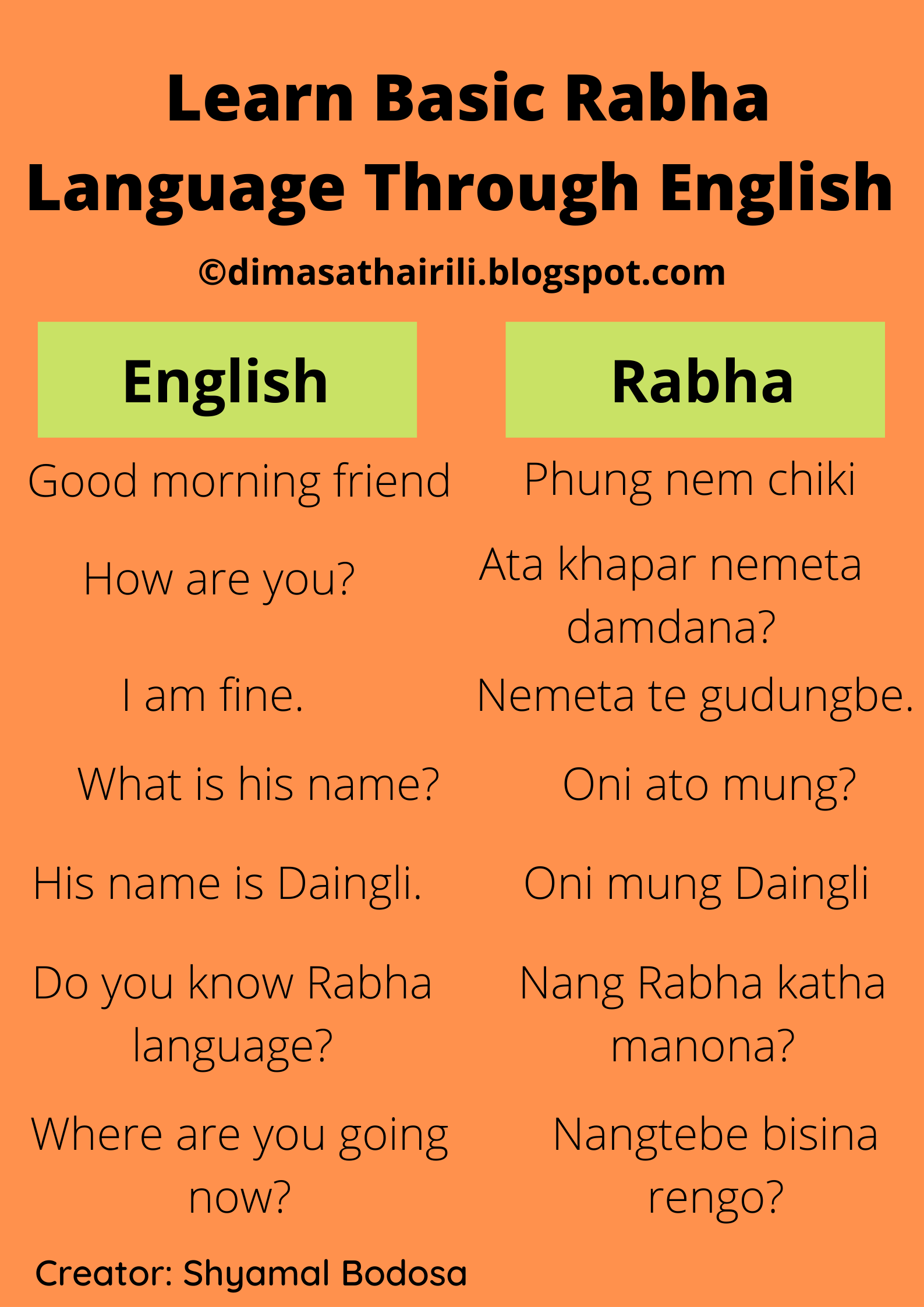
The Rabha is a spoken language of the Rabha community, and it falls under the Bodo group of the Assam branch of the Tibeto-Burman languages of the Sino-Tibetan language family. But the language has now lost its original tonal characteristics.
The Rabha language shows that the other allied tribes such as Bodo, Garo, Tiwa (Lalung), Kokborok, Dimasa kachari, Deuri, Chutiya, etc. are sister languages and Karbi (Mikir), Mishing (Miri), Apatani, Chin, Tai, etc. have some similarities with the Rabha language. The dialects of the Rabha language differ from area to area. Mainly Rangdani, Maitori, and Koch are the primary dialects. Besides them, there are a few other sub-dialects of the Rabhas. In the discussion of the Rabha vocabularies, all these dialects are taken into consideration.
 |
| Learn Basic Rabha Language |
The sources of the Rabha vocabulary are of two types:
- Basic words
- Loan words
Basic words and loan words are further sub-categorized as below –
- Basic– Tibeto-Burman Original
- Loan– Non-Tibeto-Burman.
Loan words are mainly incorporated into the Rabha language through the Assamese language.
Basic words: The sources of the Basic words are the Sino-Tibetan languages.
I – An
Water – Cika
Bird – To
Cat – Minku
Assamese words loaned in Rabha:
King – Raja
Queen – Rani
Knowledge – Bidya
Temple – Mandir
Rabha Language Words and Phrases
The Rabha words we use frequently in daily life are exemplified below.
| No. | English | Rabha |
|---|---|---|
| 1 | Good morning friend | Phung nem chiki |
| 2 | How are you? | Ata khapar nemeta damdana? |
| 3 | I am fine | Nemeta te gudungbe |
| 4 | Are you going anywhere? | Nang benga ba rengjo ne? |
| 5 | I am not going anywhere | Ang jachinniba rengcha |
| 6 | Have you taken your meal? | Nang may sajo na? |
| 7 | Which curry are you cooking? | Nang ato mi ruymjo? |
| 8 | I am cooking dal | Ang dali ruymjo |
| 9 | She has not come? | O, riba khusa? |
| 10 | Where are you going now? | Nangtebe bisina rengo? |
| 11 | I am going to Guwahati | Ang tebe Guwahatina rengo |
| 12 | Is the baby crying? | Kay sabrare khapeta? |
| 13 | The baby is crying | Kay sabrane khapeta |
| 14 | What is his name? | Oni ato mung? |
| 15 | His name is Daingli | Oni mung Daingli |
| 16 | In which village do you live? | Nangi nak bekay sangi? |
| 17 | My house is in Komorakata village | Angi nak komorakata sangi |
| 18 | There is no fish in this pond | Ekay pakhari na tangisa |
| 19 | Will you sing a song? | Nang chay chay runga krykana? |
| 20 | Do you know the Rabha dialect? | Nang Rabha katha manona? |
| 21 | I know the Rabha dialect | Ang Rabha katha mano |
| 22 | All birds are of the same feather | Dimdakan ali gosayni may |
| 23 | The fortunate earns respect | Kopal nangkay kay kayni sanman manna |
| 24 | The aged should be venerated | Kay chungbatango urgina lagiya |
| 25 | Danger hardly befalls the careful. | Ki mukhar mankay kay bipadina kicha |
| 26 | One who seas is usually the one without shame | Jani kumpak tangcha use nemkhakay kami ra |
| 27 | Parents words are always significant | Babra-jurani katha koba renga tangcha |
| 28 | I | An |
| 29 | My | Ani |
| 30 | My also | Anba |
| 31 | Me | Ana |
| 32 | Myself | A nan |
| 33 | For me | Ani badan |
| 34 | You | Nan |
| 35 | Your | Nani |
| 36 | Your self | Nankakay |
| 37 | He/she | O |
| 38 | Her | Isi |
| 39 | Him | Uo |
| 40 | They | Oran |
| 41 | Their | Orani |
| 42 | Them | Orano |
| 43 | Not understand | Faman cha |
| 44 | Where | Bisi |
| 45 | Tomorrow | Gaphuri |
| 46 | Somehow | Oganda |
| 47 | Poetry | Chay |
| 48 | Language | Khurang |
| 49 | Rice | May |
| 50 | Thank you | ? If you know Thank you means in Rabha, please let me know through comment or contact us. |
Explore More Related Articles