The Mising language belongs to the Sino-Tibetan language family. There are over 6 lakh speakers as of the 2011 census. They are mostly found in Dhemaji, Tinsukia, Lakhimpur, Sibsagar, Dibrugarh, Sonitpur districts of Assam and some parts of Arunachal Pradesh.
In this blog, we will learn the basic Mising language words and phrases in English that you need to know. Knowing a few basic Mising words is an easy way to connect with locals.
Basic Greetings and Phrases in Mising
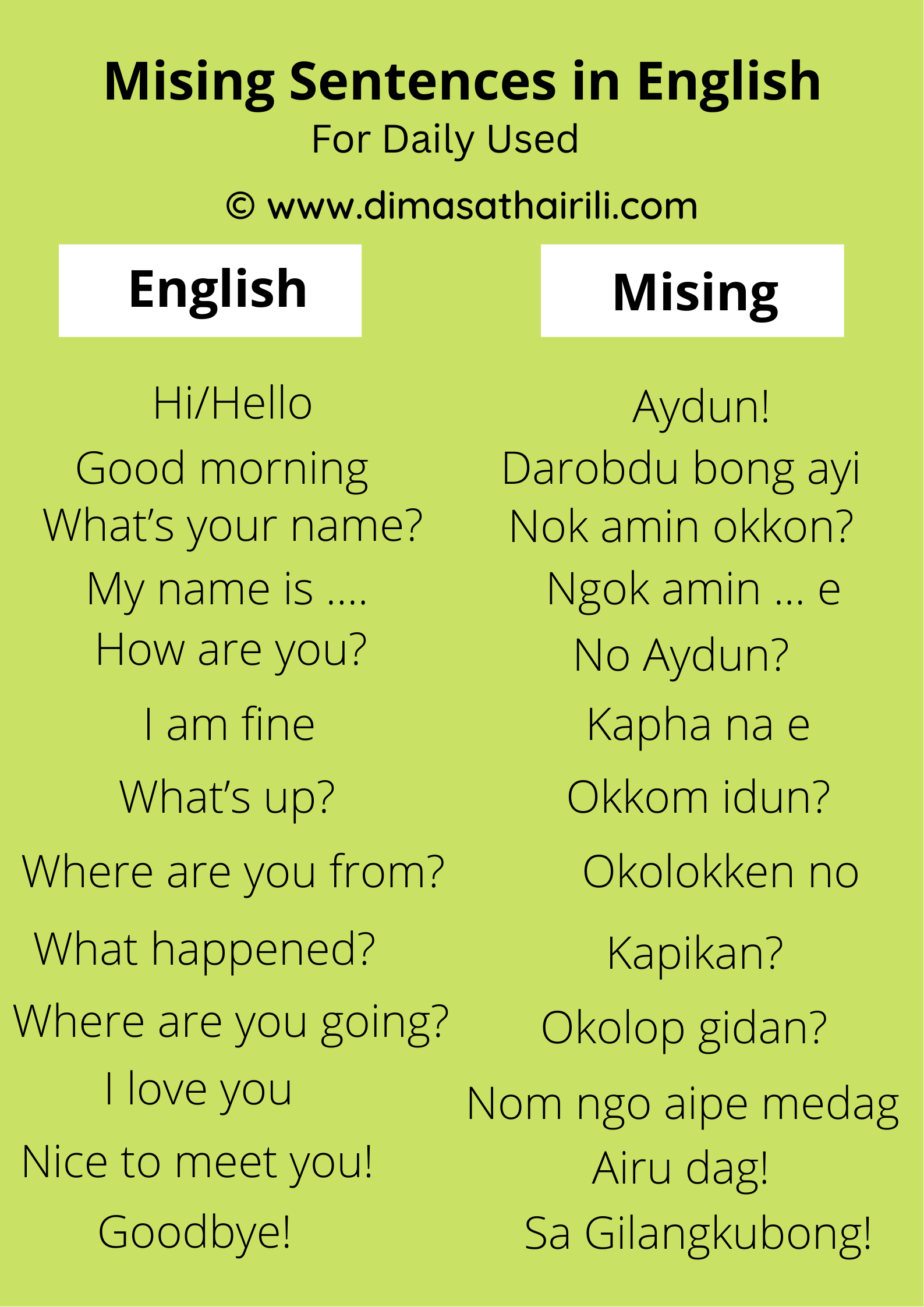
- Hello – Aydun
- What is your name? – Nok amin okkon?
- My name is ….. – Ngok amin … e
- How are you? – No Aydun?
- Where are you going? – Okolop gidan?
- Have you eaten food? – Apin dotobon?
- Not yet eaten – Domada
- I have taken – Dotobong
- I am Mising – Ngo Mising
- What happened? – Kapikan?
- Excuse me – Menyi yobong
- Let’s eat! – Kai dola boi!
- Good night – Yubla bongka
- Good morning – Darobdu bong ayi
- The sun is rising – Donye sa lending
- The sun is setting – Donye oa dung
- Don’t worry – Me diryo
- Don’t make noise – Urradyo
- Nice to meet you! – Airu dag!
- I’m leaving – Ngo gipo dakkubong
- Goodbye! – Sa Gilangkubong!
Check Also: Basic Assamese Words and Phrases
70 Mising Language Words for Daily Use
Below, we have listed the most commonly used Mising words, such as Animals, Birds, Body parts, Vegetables, Fruits, Kinship terms, and more. Knowing these words makes it easier to speak the Mising language.
| No. | English | Mising |
|---|---|---|
| 1 | I | Ngo |
| 2 | You | No |
| 3 | He/She | Bi |
| 4 | They | Bulu |
| 5 | It | Ede |
| 6 | This | Se/Isi |
| 7 | Here | So/Iso |
| 8 | There | Tolo/to |
| 9 | Father | Abu |
| 10 | Mother | Ane |
| 11 | Grandfather | Tato |
| 12 | Grandmother | Yayo |
| 13 | Brother (elder) | Kai/Kaiye |
| 14 | Sister (elder) | Bai/Baye |
| 15 | Brother (younger) | Biro/Ange |
| 16 | Sister (younger) | Birme |
| 17 | Son | Ao |
| 18 | Daughter | Ome |
| 19 | People | Tani |
| 20 | Male | Milbo tani |
| 21 | Female | Ne tani |
| 22 | Friend | Ajon |
| 23 | Student | Porine |
| 24 | Eye | Amig |
| 25 | Ear | Yerung |
| 26 | Nose | Yebung |
| 27 | Mouth | Nappang |
| 28 | Tooth | Aye |
| 29 | Head | Mittug |
| 30 | Hair | Dumid |
| 31 | Face | Migmo |
| 32 | Hand | Alag |
| 33 | Foot | Ale/Letig |
| 34 | Dog | Iki |
| 35 | Cat | Mendari |
| 36 | Pig | Eyeg |
| 37 | Cow | Sobo/Goru |
| 38 | Goat | Soben |
| 39 | Horse | Gure |
| 40 | Mouse | Kebung |
| 41 | Chicken | Porog |
| 42 | Bird | Pettang |
| 43 | Fish | Ongo |
| 44 | Flower | Appun |
| 45 | Grass | Nesin |
| 46 | Tree | Ising |
| 47 | Leaf | Anne |
| 48 | Fruit | Aye |
| 49 | Red | Li’ne |
| 50 | Blue | Nilane |
| 51 | Yellow | Aldiyane/Tupunne |
| 52 | Green | Gene |
| 53 | White | Kampone |
| 54 | Black | Yakane |
| 55 | Day | Longe |
| 56 | Night | Yume |
| 57 | Year | Diatg |
| 58 | Sun | Donyi |
| 59 | Moon | Polo |
| 60 | Stars | Takar |
| 61 | Earth | Mopi |
| 62 | Fire | Imi |
| 63 | Water | Asi |
| 64 | Air | Esar |
| 65 | Sky | Domir |
| 66 | Sea | Gane |
| 67 | Mountain | Adi |
| 68 | Forest | Si lung |
| 69 | Left | Lakke |
| 70 | Right | Lagbig |
Learn Mising Numbers 1 to 10
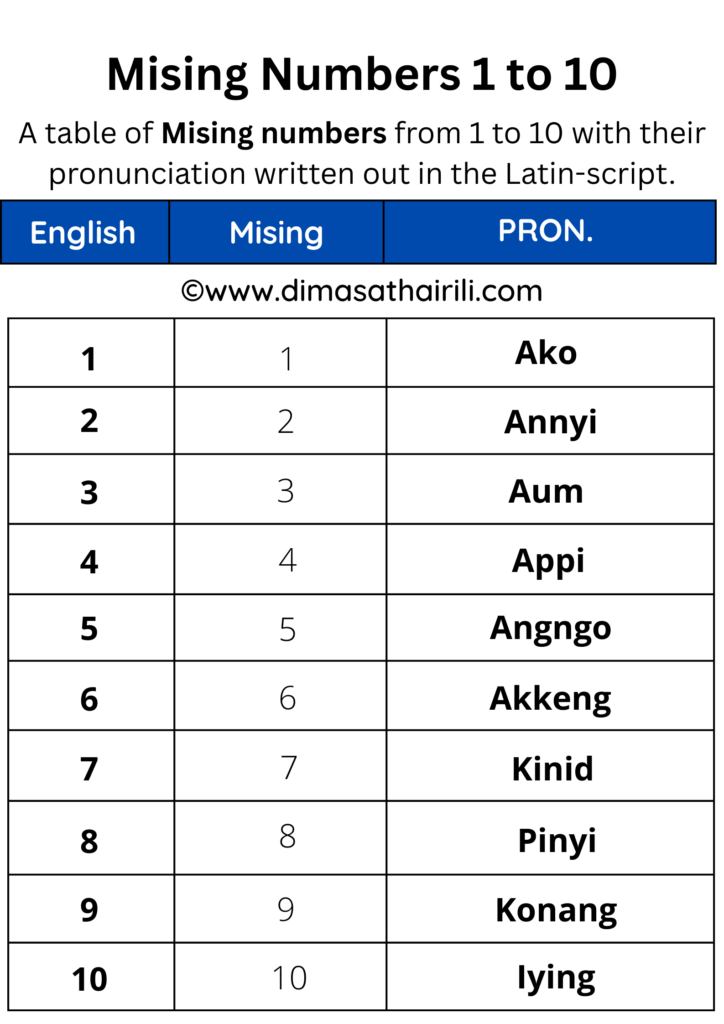
| English Numbers | Mising Numbers |
|---|---|
| 1 (One) | Ako |
| 2 (Two) | Annyi |
| 3 (Three) | Aum |
| 4 (Four) | Appi |
| 5 (Five) | Angngo |
| 6 (Six) | Akkeng |
| 7 (Seven) | Kinid |
| 8 (Eight) | Pinyi |
| 9 (Nine) | Konang |
| 10 (Ten) | Iying |
I hope you like this post! If you would like to make any changes or corrections to this post. Please let me know by contacting me here.
Explore More Related Posts:
- Learn Apatani Language Words in English
- Basic Nyishi Language Words and Phrases
- Learn Basic Rabha Language Words
- Learn Bodo Language Words in English
FAQs on Mising Language
You can say I love you in Mising as “Nom ngo aipe medag“.
The translation of “What is your name?” in Mising is Nok amin okkon? .
You say “What are you doing?” in Mising as “Ekkom edun?“.
You can ask “How are you?” in Mising as “No aydun?“.
Hi, this is Shyamal Bodosa, a part-time blogger from the Northeastern Indian state of Assam. I started blogging in 2018 and have 8 years of experience, yet I continue to work consistently in the field. My goal is to collect the world’s languages and make linguistics accessible to all. Thank you