The Bodo language (also called Boro) is one of the most prominent languages of Northeast India. Originally, the language belongs to the Sino-Tibetan language family. This language is closely related to the Dimasa, Kokborok, and Garo languages of Assam, Tripura, and Meghalaya. The Bodo language is one of the 22 languages recognized by the government of India and included in the 8th Schedule of the Indian Constitution.
Basic Greeting Words in Bodo
Knowing a few basic phrases and words in Bodo. This is the best way to learn the Bodo language.
- Hello – Khulumbai!
- Welcome – Ador khalamnai
- What’s up? – Ma khalamdw?
- What’s your name? – Nwngni munga ma?
- How are you? – Ma khobor?
- Good morning – Gwjwn fungbili!
- Good night – Gwjwn hor
- Bye – Gwjwngthu!
45+ Bodo Language Words and Phrases
Besides greetings, these are some useful phrases and Bodo words to memorise.
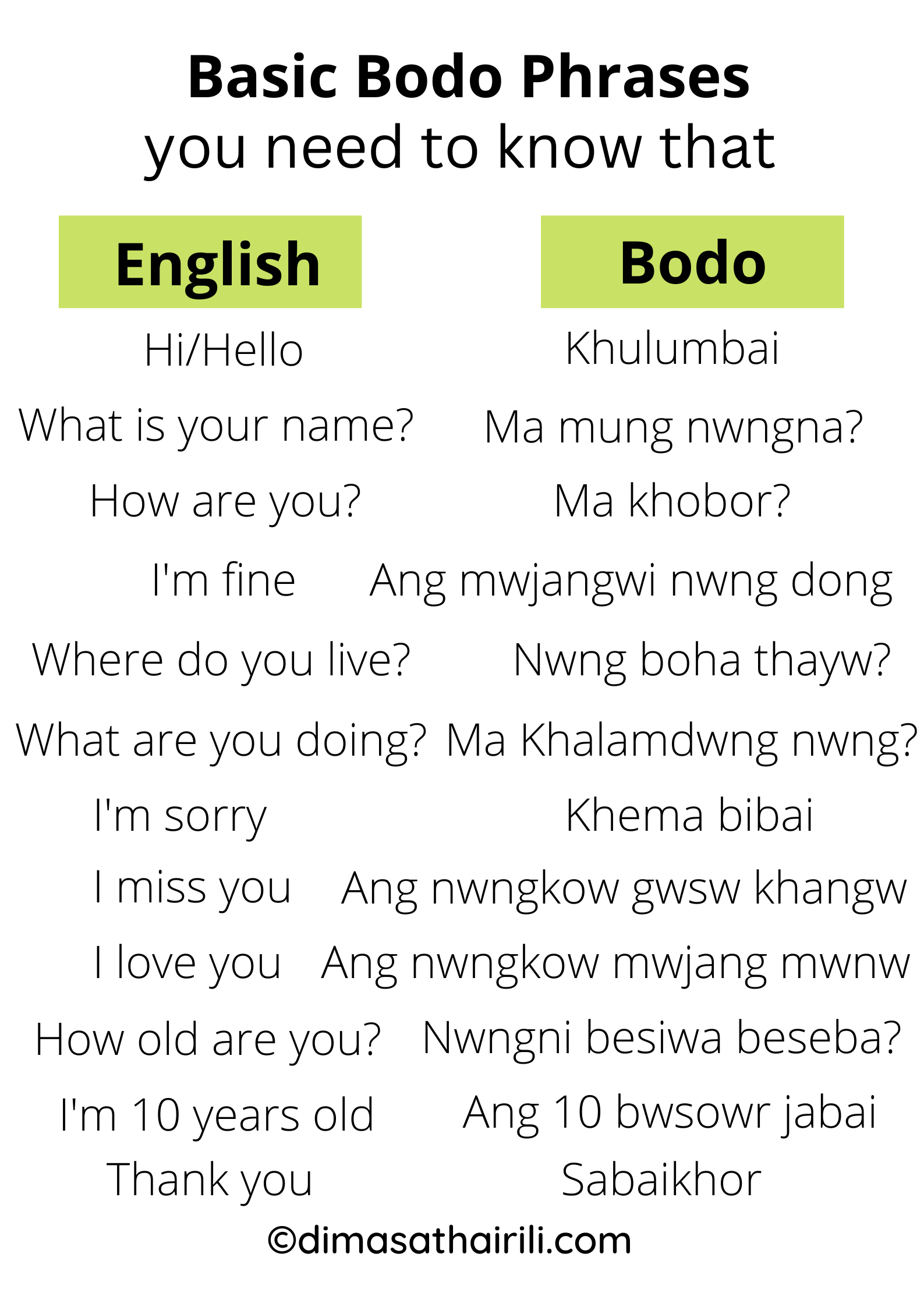
| No. | English | Bodo |
|---|---|---|
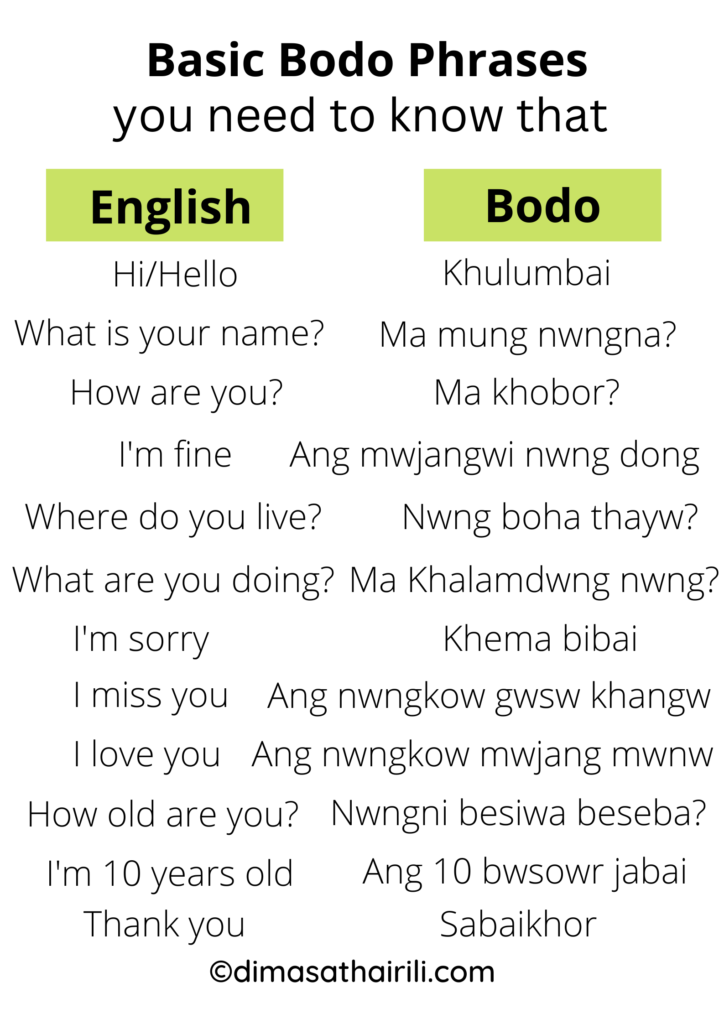
| 1 | Hi/Hello | Khulumbai |
| 2 | What is your name? | Ma mung nwngna? |
| 3 | My name is Baoringdao | Angni mung a Baoringdao |
| 4 | How are you? | Ma khobor? |
| 5 | I am fine | Ang mwjangwi nwng dong |
| 6 | Where are you from? | Nwng bode jaiga ni? |
| 7 | I’m from Assam | Ang Assam ni |
| 8 | What do you do? | Ma khalamw nwng? |
| 9 | I do a job? | Ang sakhri maoyw |
| 10 | Where do you live? | Nwng boha thayw? |
| 11 | Nice talking to you | Nwngjwng railaina mwjang mwndwng |
| 12 | What are you doing? | Ma Khalamdwng nwng day? |
| 13 | I’m doing nothing | Ang awrwinw dong |
| 14 | I’m sleeping | Ang undun dwng |
| 15 | What about you? | Nwngnalai maewi? |
| 16 | She is a beautiful girl | Beyw sase somaina sikhwla mwn |
| 17 | I’m happy | Ang gwjwnbai |
| 18 | He has just left | Biyw dasw thangbai |
| 19 | Daingli has to come here | Daingli ya beyau fwinangou |
| 20 | What happened? | Ma jakhw? |
| 21 | Don’t make me angry! | Angkow raga fwjwng nanga! |
| 22 | I’m feeling sleepy | Ang undun awngkharbai |
| 23 | It is very hot today | Dinwi jwbwd |
| 24 | Do you know to cook? | Nwng songnw rwngou nama? |
| 25 | Can you speak English? | Nwng English railainw rwngou na? |
| 26 | I want to learn Bodo language | Ang Bodo swlwngnw lugwidng |
| 27 | I like you | Ang nwngkow posaiyw |
| 28 | Do you love me? | Nwng angkow mwjang mwnbai na? |
| 29 | I love you | Ang nwngkow mwjang mwnw |
| 30 | I love you too | Angbw nwngkow mwjang mwnw |
| 31 | I miss you | Ang nwngkow gwsw khangw |
| 32 | I hate you | Ang nwngkow swiya |
| 33 | How old are you? | Nwngni besiwa beseba? |
| 34 | I am 10 years old | Ang 10 bwsowr jabai |
| 35 | Did you eat food? | Nwng jwmwng jabai nama? |
| 36 | Are you fever? | Nwng lwmjadw nama? |
| 37 | Can you come here on Monday! | Nwng sombar ao beohai fwinw hagwn nama! |
| 38 | Yes, I’ll go on Monday | Au, Ang sombar thangwn |
| 39 | I’m busy | Ang besto |
| 40 | Goodbye | Mwjwng thangnwse |
| 41 | I’m sorry | Khema bibai |
| 42 | Please forgive me! | Onanwi nimaha hwdw angkow! |
| 43 | Yes | Aw |
| 44 | No | Nonga |
| 45 | Thank you | Sabaikhor |
Learn Bodo Numbers 0 to 10
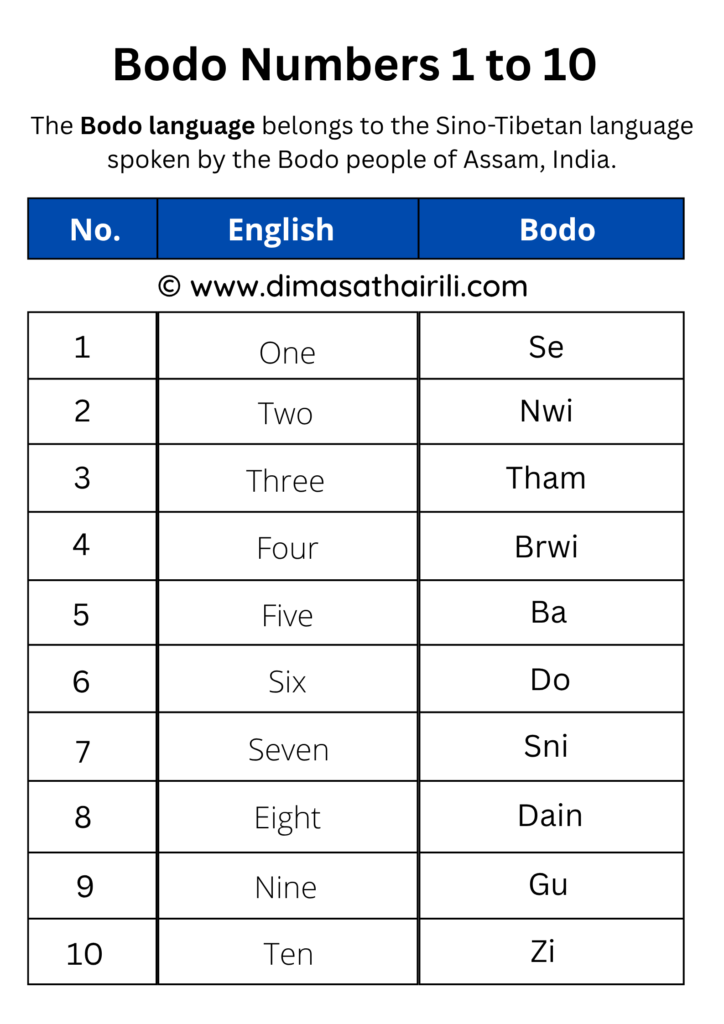
| No. | English | Bodo |
|---|---|---|
| 0 | Zero | Lathikho |
| 1 | One | Se |
| 2 | Two | Nwi |
| 3 | Three | Tham |
| 4 | Four | Brwi |
| 5 | Five | Ba |
| 6 | Six | Do |
| 7 | Seven | Sni |
| 8 | Eight | Dain |
| 9 | Nine | Gu |
| 10 | Ten | Zi |
If you want to learn Bodo numbers from 0 to 100.
I hope you enjoy learning Bodo language words and phrases. If you would like to make any changes or corrections to this post, please let me know by leaving a comment or contacting me.
We also have the names of Animals, Birds, Color Names and Fruits in the Bodo language.
FAQs on the Bodo Language
Ans: I love you is called “Ang nwngkhou mwjang mwnw” in the Bodo language.
Ans: Thank you means “Sabaikhor” in Bodo.
Ans: I am sorry, is “Khema bibai” in Bodo.
Ans: The way to say Hi/Hello in the Bodo language is “Khulumbai”.
Ans: Ask this way What is your name in Bodo is “Nwngni munga ma?”
Hi, this is Shyamal Bodosa, a part-time blogger from the Northeastern Indian state of Assam. I started blogging in 2018 and have 8 years of experience, yet I continue to work consistently in the field. My goal is to collect the world’s languages and make linguistics accessible to all. Thank you