The Konyak language belongs to the Sino-Tibetan language family, spoken by the Konyak Naga people of the northeastern Indian state of Nagaland and some neighbouring parts of Myanmar. It is the largest Naga tribe in Nagaland, with around 3 lakh speakers.
In this blog, you will find easy everyday words, phrases, counting numbers, body parts, animals, and weekday names translated into English. Let’s start learning together!
Basic Greetings and Phrases in Konyak
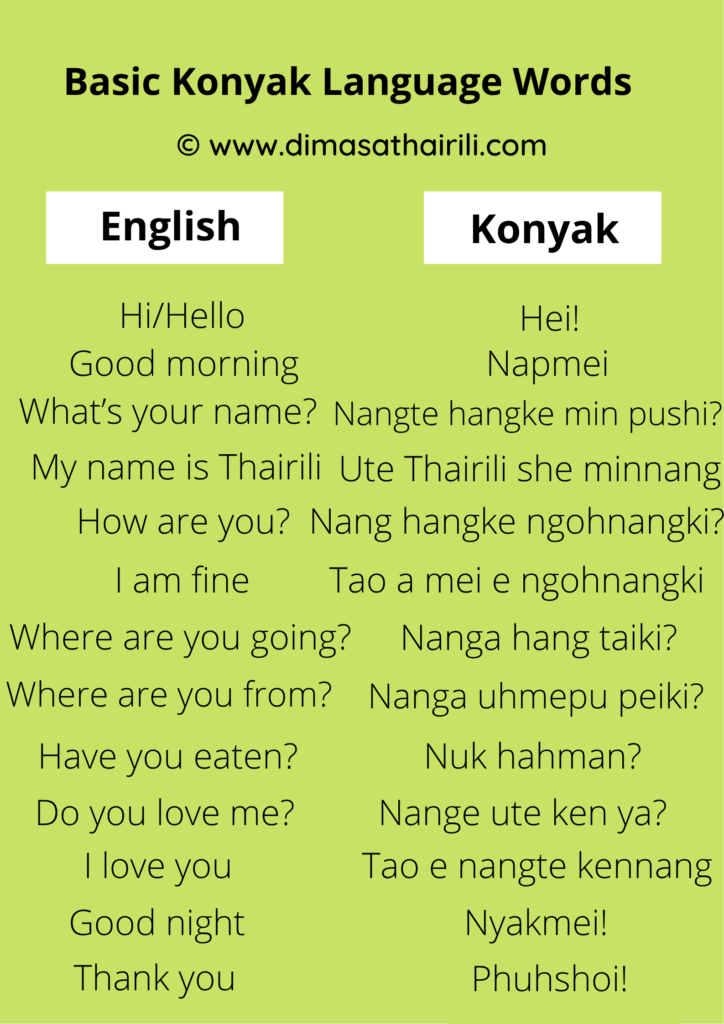
- Hi/Hello – Hei!
- Good morning – Napmei
- Welcome – Mongmeipeih
- What is your name? – Nangte hangke min pu shi?
- My name is Thairili – Ute Thairili she minnang
- How are you? – Nang hangke ngohnangki?
- I am fine – Tao a mei e ngohnangki
- What are you doing? – Nanga hanghi lingangki?
- Where are you going? – Nanga hang taiki?
- Where are you from? – Nanga uhmepu peiki?
- Who are you? – Nanga aohi shi?
- Do you know me? – Nangpe ute shingya?
- I know you – Tao e nangte shing nang
- Have you eaten? – Nuk hahman?
- I have eaten – Hah yangki
- Do you love me? – Nange ute ken ya?
- I love you – Tao e nangte kennang
- Good night – Nyakmei!
- Goodbye – Yanpu salam!
- Thank you – Phuhshoi
Read also: Learn Nagamese Words and Phrases in English Online
Body Parts Names in Konyak and English
| English | Konyak |
|---|---|
| Human | Kahta |
| Body | Pum |
| Head | Sang |
| Brain | Jelu |
| Hair | Sangmin |
| Face | Seta |
| Eye | Miik |
| Ear | Na |
| Nose | Nateng |
| Mouth | Ju |
| Moustache | Jumin |
| Lip | Jupin |
| Tooth | Pha |
| Tongue | Yi |
| Chin | Tahvanjean |
| Neck | Ung |
| Shoulder | Phakteang |
| Arm | Yakshe |
| Hand | Yak |
| Thumb | Yakpinyu |
| Finger | Yaklan |
| Chest | Chakhuh |
| Belly | She |
| Heart | Mongjang |
| Kidney | Titoi |
| Liver | Khah/Mongphang |
| Back | Dok |
| Leg | Ya |
| Knee | Yatuh |
| Foot | Yapha |
| Toes | Yalan |
| Bone | Van |
| Skin | Shu |
| Nerves | Lah |
Animal Names in Konyak-English
Animal is called Yinmok.
| English | Konyak |
|---|---|
| Cow | Mahu |
| Dog | Koi |
| Pig | Ak |
| Goat | Yon |
| Sheep | Nyee |
| Buffalo | Teck |
| Mithun | Nya |
| Cat | Ami |
| Bear | Shupnyu |
| Deer | Meishi |
| Donkey | Kato |
| Elephant | Meinyu |
| Horse | Koveipong |
| Fox | Heyan |
| Tiger | Shahnyu |
| Lion | Mailang |
| Monkey | Meiha |
| Rat | Yuh |
| Squirrel | Pekhao |
| Ant | Tuvo |
| Bug | Lengheng |
| Mosquito | Monjung |
| Snake | Pu |
| Spider | Mak |
| Earthworm | Puhun |
| Leech | Aht |
| Cockcroach | Lepla |
| Bee | Nyatai |
Weekday Names in Konyak and English
| English | Weekday Names in Konyak |
|---|---|
| Sunday | Hatnyih |
| Monday | Hatja |
| Tuesday | Hatnyi |
| Wednesday | Hatlum |
| Thursday | Hatpeli |
| Friday | Hatnga |
| Saturday | Hatwok |
Konyak Numbers 1 to 10
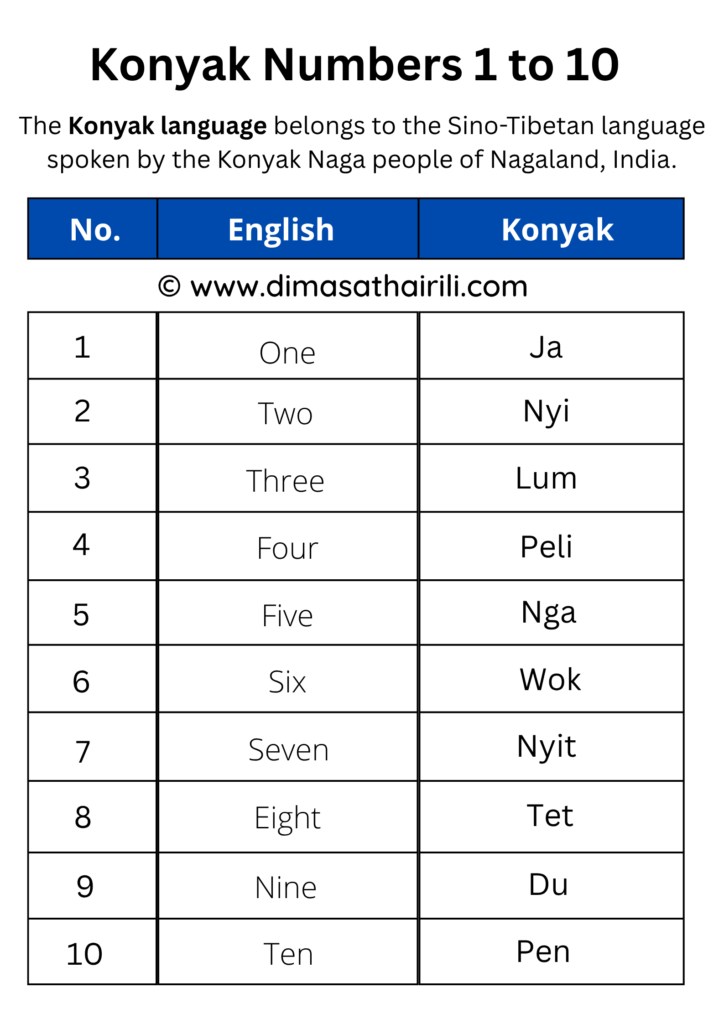
- One – Ja
- Two – Nyi
- Three – Lum
- Four – Peli
- Five – Nga
- Six – Wok
- Seven – Nyit
- Eight – Tet
- Nine – Du
- Ten – Pen
I hope you liked it! Here we’ve covered all the basic Konyak language words, everyday phrases, numbers, body parts, and animal names, all in one place. If you would like to make any changes or corrections to this post, let me know by commenting/contacting us here.
FAQs on the Konyak language
You can say I love you in Konyak as “Tao e nangte kennang“.
It translates to How are you? in Konyak is “Nang hangke ngohnangki?“.
It translates directly into Konyak: “Tao e nangte kennang“.
I love you is said as “Moi aapni ke morom kore” in Nagamese.
Hi, this is Shyamal Bodosa, a part-time blogger from the Northeastern Indian state of Assam. I started blogging in 2018 and have 8 years of experience, yet I continue to work consistently in the field. My goal is to collect the world’s languages and make linguistic accessible to all. Thank you