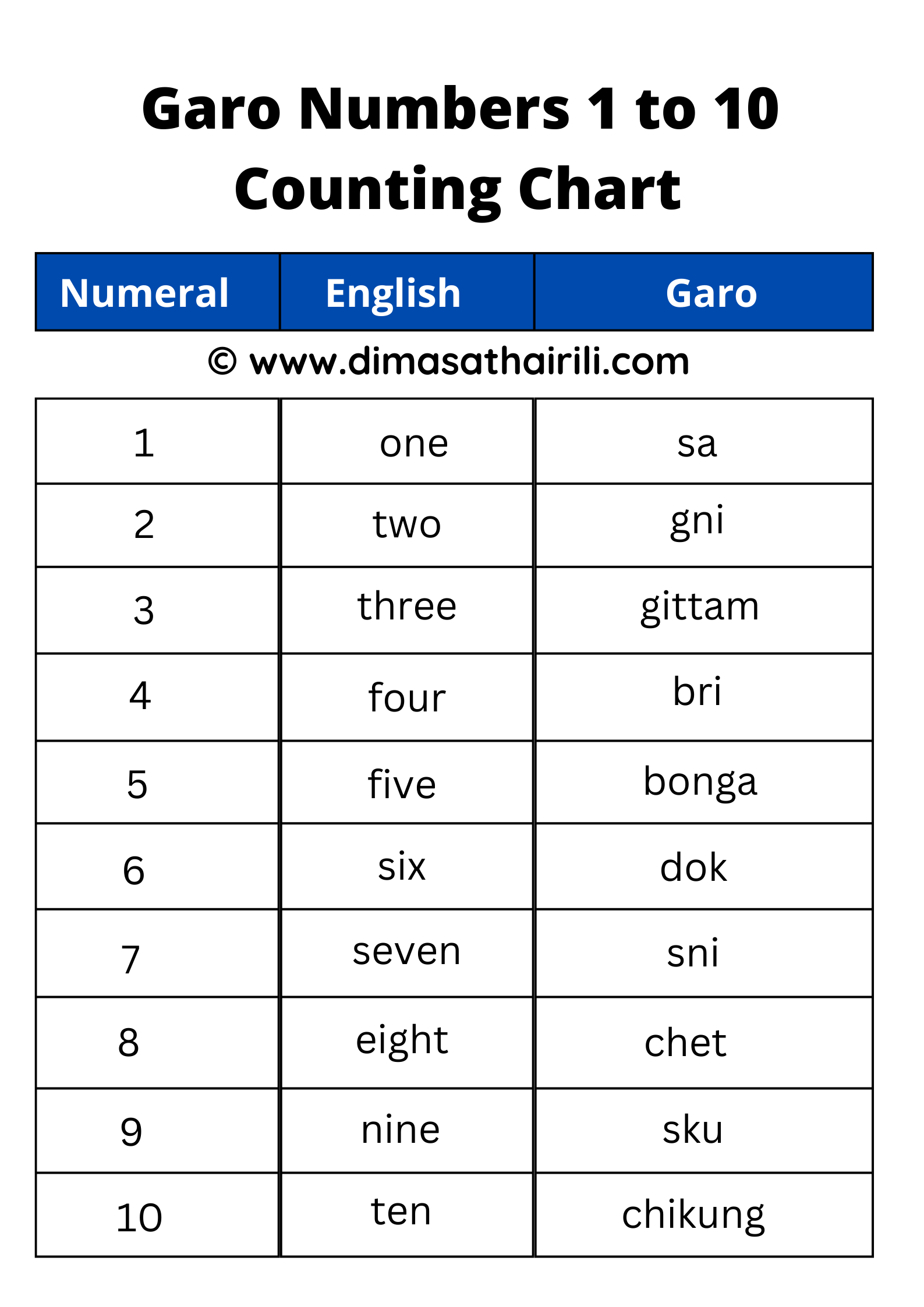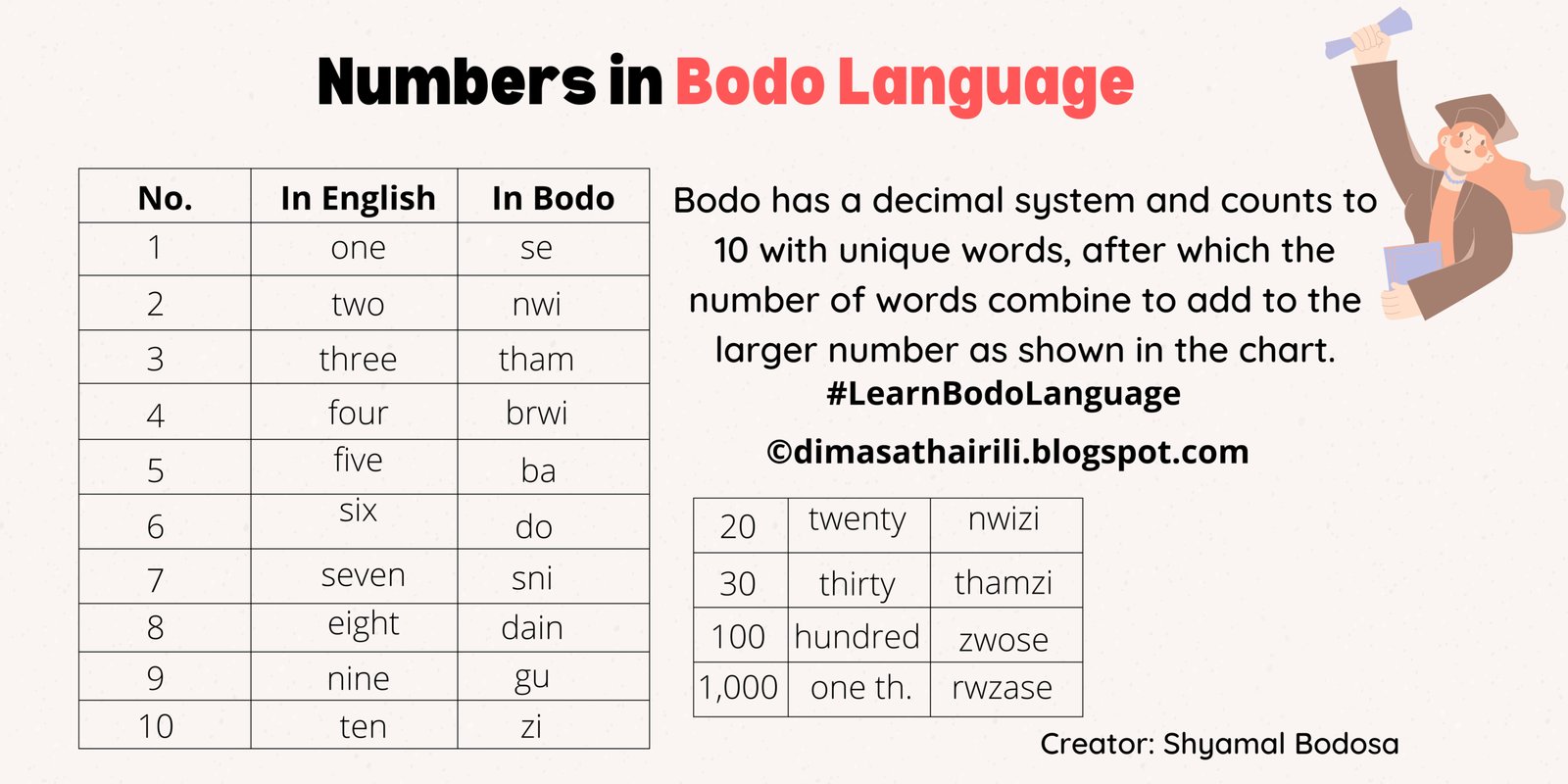
Numbers in Bodo Language| Bodo Numbers from 1 to 100

 Bodo numbers 1 to 100 are easy to learn if you know the Bodo language. Learning the numbers in any language helps a lot in conversation and also enhances the ability to learn the language better. So, if you are looking to learn Bodo, learning Bodo numbers from 1 to 100 is a good way … Read more

An Overview of Traditional Rice Beer Judima | Dimasa Rice Beer

 Judima is the most popular homemade rice beverage of the Dimasa tribe of North East India since immemorial times. Judima derives its name from Ju which means wine and Dima means Dimasa. Judima is prepared by fermentation
using yeast cake made from rice mixed with plant barks (Thembra Dimasa, Acacia
Pennata) containing different phytochemicals broadly described as
phytoestrogens, terpenoids, carotenoids, limonoids, phytosterols,
glucosinolates, polyphenols, flavonoids, isoflavonoids, and anthocyanidins. They
have a tremendous impact on the health care system and may invite medical health problems
including many diseases and physiological disorders. These phytochemicals, may
sometimes either alone and/or in combination, have tremendous therapeutic
potential also in curing various ailments.
Table of Contents

  1. How do you prepare to make Hamao?
  2. Why Judima& Juharo is so important in Dimasa society?
  3. How many types of Ju?
  4. Conclusion
  5. Reference

Traditional Rice Beer Judima constitutes an integral part
of the dietary culture of Dimasa’s Community. The Judima has a very strong
alcoholic content as claimed by the tribe, the concentration which needs to be
assayed quantitatively. The biochemical analysis of the fermented rice beer Judima has been documented.

How do you prepare to make Hamao?

How do you prepare to make Humao or Hamao?

You’ll need these things to make Hamao: A sun-dried mixture
of Thembra plant (Acacia pennata) twigs and pre-soaked rice. Buddleja Asiatica leaves
are also added for variation of flavor and taste. The mixture of powdered
Hamao is added and small spheres are prepared. Each sphere weighs about 10 g.
For Judima preparation pre-boiled cooled rice (roughly 1 kg) is mixed with one
sphere of Hamao and kept in an air-tight container. After 5-7 days a yellow
color juice comes out of the mixture, and it is called Judima.

Why Judima & Juharo is so important in Dimasa society?

Judima and Juharo are essential to solemnize their marriage
and mourn the death ceremony. Traditionally, new married bride visits her parent’s
house once a year, when she returns back to her husband’s house she should
carry the Judima. The traditional festival ‘Busu Dima‘ of Dimasa is celebrated
with freshly prepared Judima. In the death ceremony, freshly prepared Judima is
offered to dead persons and also to ancestors. Guests are also served with
Judima. Without Judima no celebration or religious ceremony is completed.

How many types of rice beer are in Dimasa society?

In Dimasa society, there are three types of traditional rice beer namely;

  1. Judima
  2. Juharo
  3. Judi

Conclusion

Ju production is a
home-based unorganized industry practiced mainly by rural women using their
native skills of alcohol fermentation and some are economically dependent upon
this product. The income earned is spent on children’s education and the purchase
of essential commodities. It was observed during the survey that despite the popularity of these ethnic fermented foods and beverages of the Dimasa tribe of Assam,
both from cultural as well as economic points of view, no affords by State
Government or corporate sectors have been made to promote these ethnic foods
and drinks. Even these culturally rich ethnic foods have not been included in
any financial institutions, small cottage industries for employment generation,
and food processing programs. We recommend that the ethnic fermented foods
and alcoholic drinks of NC Hills of Assam should be included in the government’s food processing section to enhance the regional economy, generation of employment, and promotion of the age-old food culture of Assam in the
global markets. The role of indigenous women in NC Hills of Assam in the production
and marketing of ethnic fermented foods and beverages should be highlighted.

Read more

139th Death Anniversary of the Freedom Fighter Veer Sambudhan Phonglo

 Observation 139th death  anniversary of the freedom fighter Veer Sambudhan Phonglo by Dimasa Lairidim Mel at Komorakata, Hojai. The presence of the members of Dimasa Students Association, Senior citizens, Dimasa society of the village, and others. The guest honor Mr. Ramesh Thousen (President of Dimasa Sahitya Sabha) and Mr. Kumud Bodosa’s son Mr. Bhaskarjyoti Bodosa (Professor … Read more

Grao-Jma: Khusi-habah salaibaha nisini juruma odeh phailaima asha khlailadu abo laijomakhe rihi

 Grao-Jma: Sagang thaoha nisi khribne hamjaoma-khasaoma yaophaladu : Nisine khanariladu, Hojai Dist. Dimasa Lairdim Mel(Dimasa Sahitya Sabha) pogosong jahi salaiyaba, Veer Sambudhan Phonglo ni (139th Death anniversary) thiba basainkhe 12 February, sainsri khali Komorakata, Dimasa Lairidim Melni nohmah baklaha riyaba khusi-habakhe laphahi mel salai laidu. Okhali melni khirib khusi-habah salaibaha nisini jurumah maima odeh phailaima … Read more

Dimasa Sahitya Sabha (Dimasa Lairidim Mel)

 Dimasa Sahitya Sabha or Dimasa Lairidim Mel is founded on 26th February, 1999. It promotes
the Dimasa culture, language, and literature. It is a non-profit organization. The headquarter
of Dimasa Sahitya Sabha(DSS) is situated in Haflong, Dima Hasao.

Dimasa Lairidim Mel, Dimasa literature
Dimasa Sahitya Sabha logo

Early Work

Dimasa Lairidim Mel was followed by another literary
program called ‘Dimasa Writer’s Forum‘. Dimasa writers have been publishing
books in Bengali-Assamese and Roman Fonts but books have been published in the
present Roman Font. Dimasa Sahitya Sabha(DSS) has also recognized this in
accepting Roman script. Dimasa language teaching is currently going on as an
optional subject in primary schools in the Dimasa-dominated areas of Dima Hasao.
Dimasa Sahitya Sabha, Dimasa Writer’s Forum has also published books.

Development

Dimasa is also working on the development of language
literature at Assam Sahitya Sabha. Tezpur University has also taken measures to
introduce diploma courses in the Dimasa language along with holding seminars on the
development of the Dimasa language in the Assam Sahitya Sabha initiative two years
ago.

Read more

Bihdu poem by Vijayananda Kemprai – Ahni Grao

Dimasa Thairili (Poem) Bihdu  Writer(Rebyah): Vijayananda Kemprai Jing ansa basa basa, Jini baothai basa basa, Hamba khebo Jing mithiya, Hamya khebo Jing tharmaiya, Baoh-jai joh-jai dong khade, Hemjai dangjai dong khade, Khasao-mah gnang mamdai rao, Naisoh dengya phamdai rao, Phirthi bubra, phlang bubra, Sain bubra, dain bubra, Ning ning dismal jing khripkhe, Ning ning dihmakhao … Read more

Dikhong Sah poem by Vijayananda Kemprai – Ahni Grao

Dikhong Sah Writer: Vijayananda Kemprai Guire guithab jini dikhong sah, Glukh-glukh bringdu, sor-sor sorlangdu. Naihisining dongthao thao, Malaohi sining dongthao thao. Hogo naiha daorili buthu jang, Birkhu-birkhlai birsodu buthu jang. Dergong dergong jaophri-jaophra, Khim jang khim majangsisi. Barsra sibdu khimling maodu, Bahai midim bar sibdu. Phai phai lugurao disakhong ha, Khaja-mini malaolai nang khimling ha. table { … Read more

Lailangyaba Maithai poem by Prozen Daulaguphu – Dimasa Thairili

  LAILANGYABA MAITHAI Rebyah: Prozen Daulaguphu Rijinggin-khonsi maithai lailangbukha Wainsomin-wainsothai haigerlang bukha. Khaha nangjaoyaba khisa thaolangkha, Sainyahi bo-braiyahi bo mailakha. Badamma bo haigerhi thanglakha. Basain gadain-maithai gadain phaibunang, Angde khinladu, gmangladu, khah maoladu. Gilim-gasa, bemar-hasar, namu-khurmu phaibunang.   Maiblaiyaba bo thangladu, girilangladu, jamlangladu. Khaha baosing baokhade khahbaisisi, Khaja-mini basain plaiyaba-adeyrao, sengphongrao, lugurao jang, Dini bo … Read more

Kinship Terms of the Dimasa

 Kinship Terminology in Dimasa: There are Kinship Terms in Dimasa, Kinship Terms of the Dimasa, Dimasa kinship terms: The most common terms are listed below. Father – Aba Mother – Amai Sister – Abi, Bibi Brother – Ada Husband – Basai Wife – Bihi Small Brother – Adong Small Sister – Aajang Daughter in law … Read more