Pronoun in Dimasa and English with Definition and Meaning – Dimasa grammar

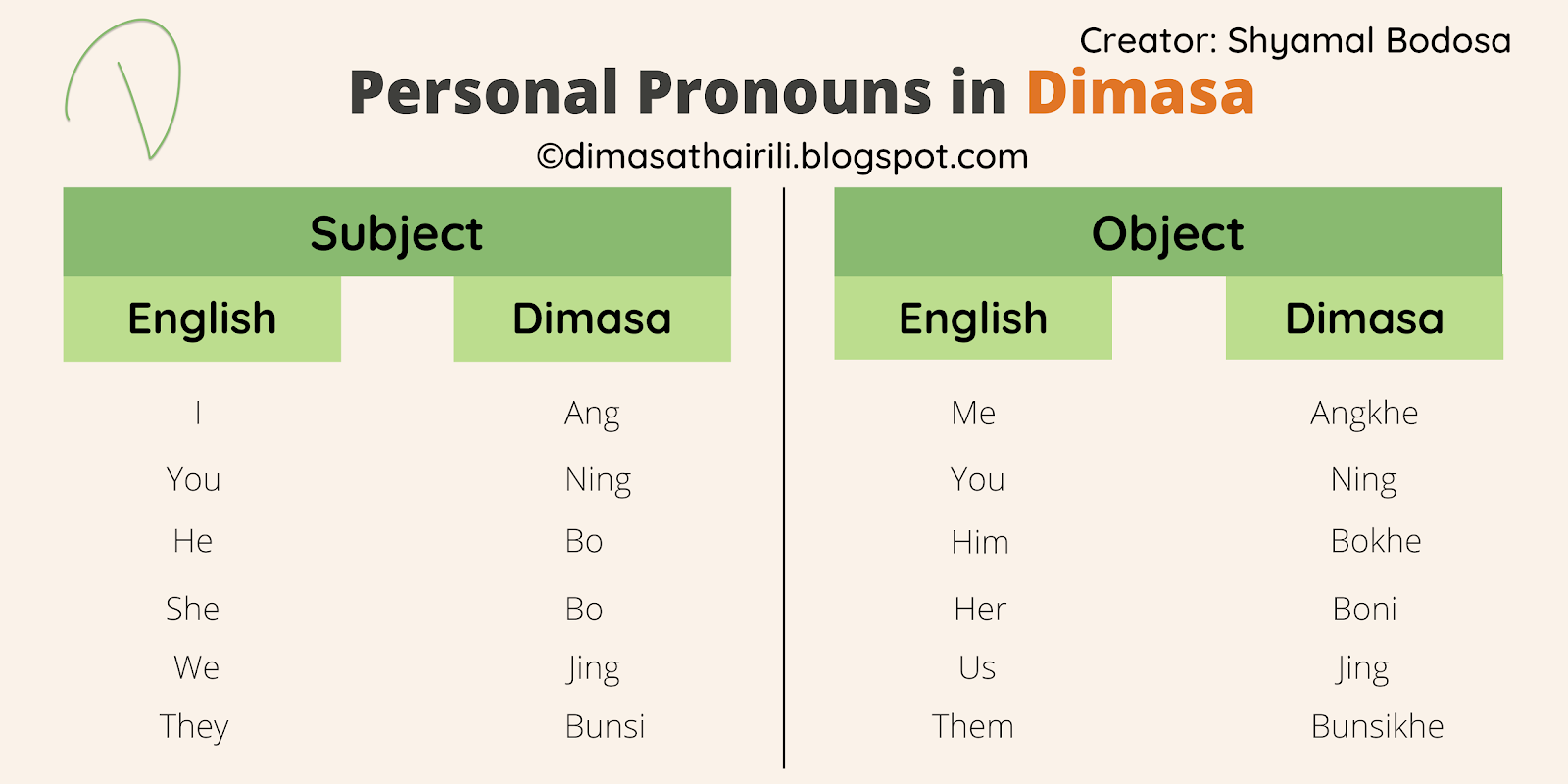
The pronoun in Dimasa and English with Definition and Meaning: Pronouns are declined in the same way as nouns but as there are some irregular forms the declensions are given in full.  Table of Contents List of Pronouns in Dimasa with Meaning Subject & Object: Personal Pronouns Cases in Dimasa Subject Pronouns Object Pronouns Subject … Read more

3 Ways to Ask “How are you?” in Dimasa

  If someone asks “How are you?” in Dimasa and how do you reply? Maybe you will be confused or you’re having a really bad day. 3 ways to ask people how they are to ensure you make a good first impression. You will feel confident with these basic Dimasa words and phrases will make such a positive difference in your … Read more

The Adjective in Dimasa Grammar : 58 Adjectives in Dimasa

 Which word describes the specialty of noun or pronoun in the sentence is called an adjective. Before noun to describe: Ani Majang Ajang – My beautiful sister. Thaiju Gimin – Ripe mango. Saam Gakhrang – Green grass. After noun/pronoun but before the verb: Bo Ane Thane Dedao – He is older than me. The adjective … Read more

Adverb in Dimasa with Definition, Meaning and Examples – Dimasa Grammar

Adverb in Dimasa with Definition, Meaning, and Examples: An adverb is a word that describes the characteristics of other words except for Nouns and Pronouns. The words that describe the characteristics of Nouns and Pronouns are called Adjectives, which you can read. Today I will tell you about Adverbs that you need to know to speak … Read more

Dimasa Sentences Used in Daily Life | Dimasa to English Translation

 The Dimasa language (also known as Grao-Dima) belongs to the Sino-Tibetan language family and is spoken by the Dimasa people in the Northeastern Indian states of Assam and Nagaland. Today, in this lesson, we will learn basic Dimasa phrases and words along with their English pronunciation. Basically, we use S+V+O in English grammar, but in the … Read more

Animals Name in Dimasa and English | Learn Dimasa Language

 Do you know all animal names in Dimasa and English? Otherwise, this article is only for you. In this article containing Animals Name in Dimasa, you have been given more than 35 Animals Name spelled with their Dimasa meaning. Remembering what you can tell the children of your house. Animals Name in Dimasa and English … Read more

Bird Names List in Dimasa with Pictures – Learn Dimasa Language

Bird Names List in Dimasa with Pictures: Birds are the most important part of nature some birds fly some don’t some have long beaks others not. What we call the Birds Name in Dimasa Language with Images. In this blog, we will be giving the most commonly seen bird’s name. Bird Names In Dimasa [Dembra … Read more

Dimasa Traditional Ornaments | Jewelry & Ornaments Names with Images

  Dimasa traditional ornaments and dresses The Dimasa people are a gay and colorful tribe. Among the tribes of Northeast Dimasa kachari being a colorful tribe, have a great interest to adore with beautiful jewelry along with their colorful traditional dresses. The Dimasa traditional ornaments are made like the color pattern of their traditional dress … Read more

12 Colours name in Dimasa and English with an image – Dimasa Thairili

Viewers, in this post you have been given a list of Colours Name in Dimasa and English with an image of colors. Colors have great importance in our life. Without it life becomes dull. In ancient times people used only natural colors. Contents Colors Name in Dimasa and English – 12 Colors Name Here is a … Read more

Baimaijai dance: Know History and Significance of the Dimasa traditional dance

 The Dimasa Kachari tribe is one of the oldest tribe in Assam, India. The Dimasa folk dance is rich in variety, featuring different types of dances, one of which is the Baimaijai dance.

Baimaijai dance
Baimaijai dance – (Art by Lakheswer Bodo)

Baimaijai is a traditional folk dance of the Dimasa.
The dance is performed by young girls or women with a Plate or a Dish, and they perform
the dance with two plates in both hands. This dance has a distinctly unique
feature. Historically, during the reign of the Dimasa kingdom, the king had come
out victorious in the war and offered victory at the Palace through delight.
The dance was also reportedly performed at that festival. The dance has gained
popularity ever since. The dance has now gained immense popularity in different
parts of India.


Dancers wear traditional outfits and ornaments like Rangbarsa (Necklace
made of coins), a drum-shaped ornament is worn on the neck, Chandrahal (Necklace
made of three silver chains with flower shapes), and Rikhaosa (Long muffler taken
by both men and women; white, green, or yellow), Rajamphain (White cloth worn from chest to knees), Rigu (Wrapper or lower garment of various colors,
worn from waist to ankle), etc. ornaments. They performed the dance with two plates
in both hands. The spirit of the song is expressed in the tunes of Kharam (Drums)
and Muri (Fife). 

Kharam and Muri(Musical instruments)
The Dimasa old men are playing Kharam and Muri.

The stunning outfit of the dancer, the ornaments, and the sparkling
sparkle of the dancing plate in hand give this dance a unique dimension. It is
truly commendable that the new generation is now devoted to retaining this
dance and has been able to give this dance a new look all over India.

Read more